
Fixed-price raffle entries. Transparent token flows.
Activity funded prizes, burns and holder rewards.
Platypus Inc started with a simple idea: build a raffle platform where the prize is locked before entries open, the draw can be verified publicly, and nobody on the team can choose the winner.
$PLATY is the token that connects every part of that system.
It is used to enter raffles. A portion of every entry is permanently burned. Another portion is distributed to Platypus NFT holders. Trading fees fund a proportional points leaderboard and acquire new raffle prizes. Those prizes bring participants back to the platform and restart the cycle.
This page explains exactly how that loop is designed to work, where the money goes and what holding one of the 1,999 Platypus NFTs does.
Every raffle entry costs $0.05
The entry price is simple: one raffle entry costs $0.05.
The price is fixed in the raffle contract. There is no admin function intended to change it, and the cost does not increase with the value of the prize. Whether a raffle features an entry-level collectible or a major NFT, the base entry price remains the same.
Entries are purchased using $PLATY.
The platform still displays the cost in dollars. At the time of entry, it calculates the amount of $PLATY required at the current market rate. This keeps the experience understandable: users see a five-cent entry rather than having to calculate what a changing number of tokens is worth.
In short
- The platform quotes every entry at $0.05.
- The user pays the equivalent value in $PLATY.
- The token amount can change with the market price, but the dollar-denominated entry price does not.
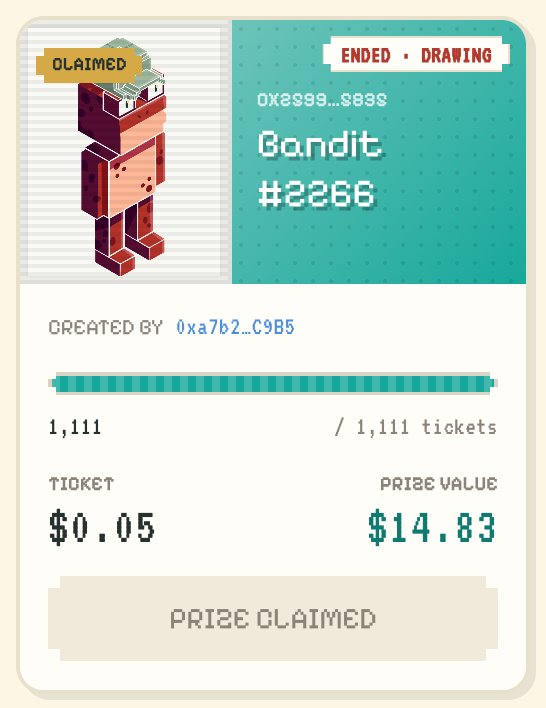
Where every $PLATY goes
The system has two independent economic streams:
- Revenue from raffle entries.
- Fees generated when $PLATY is traded.
Each stream has its own destinations. Neither is designed to pass through a discretionary treasury wallet before being allocated.
Stream A: Raffle-entry revenue
Every $PLATY payment used for an official raffle entry is split immediately:
The burn is not a future buyback promise. It is not kept aside for a later decision. The tokens are destroyed as part of the entry flow.
The remaining 30% is divided across the full collection of 1,999 Platypus NFTs every 24 hours. If one wallet holds multiple Platypuses, it receives the corresponding share for each NFT it holds.
Stream B: $PLATY trading fees
$PLATY has a 3% tax on buys and a 3% tax on sells.
Every trading-fee dollar is divided equally:
The first half rewards qualifying users in proportion to the points they earned during each 24-hour epoch. The second half restocks the raffle board with NFTs that people can compete to win.
These streams perform different jobs
| Source | Share | Destination |
|---|---|---|
| Official raffle entries | 70% | Permanently burned |
| Official raffle entries | 30% | Distributed across 1,999 Platypus NFTs |
| $PLATY trading fees | 50% | Proportional points-leaderboard pool |
| $PLATY trading fees | 50% | Acquisition of new raffle prizes |
How points work
The points system tracks economic activity in dollars, not the number of tokens someone happens to hold.
One point costs one cent of raffle-entry activity.
Because one entry costs $0.05, every paid entry earns:
This makes the system consistent even if the market price of $PLATY changes. Five dollars of qualifying entry activity produces the same number of points regardless of how many tokens were required to pay for it.
Why points count only on official Platypus raffles
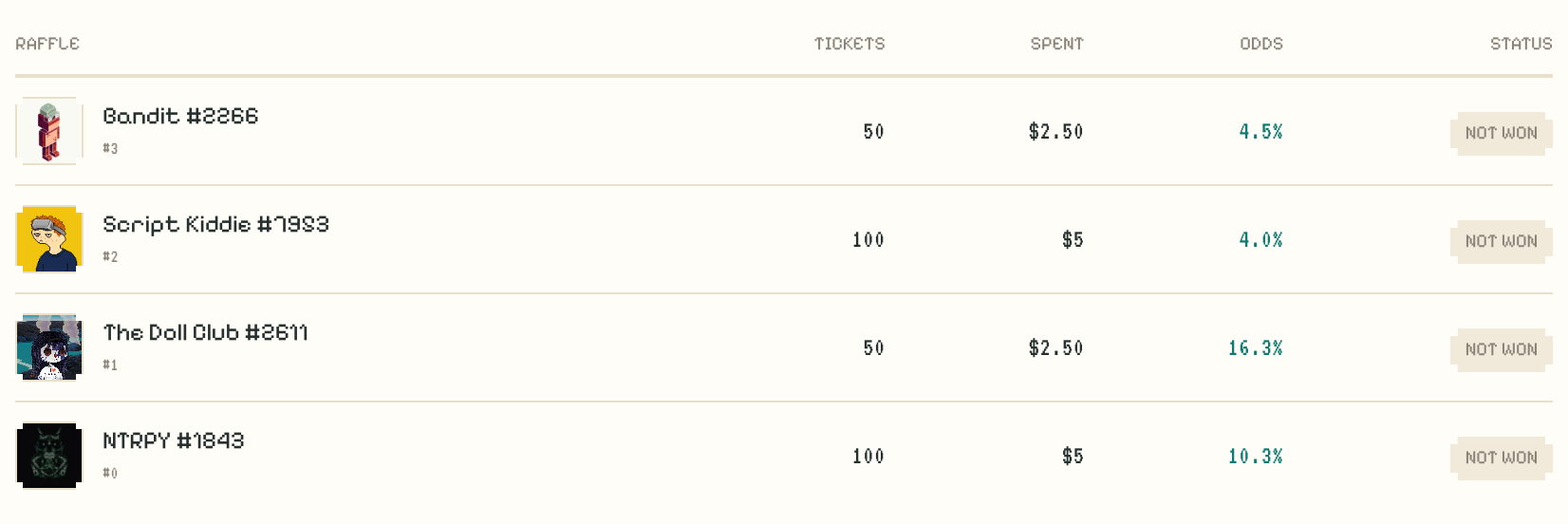
Platypus NFT holders can create raffles, but creator raffles do not generate leaderboard points.
This restriction is deliberate.
If points counted on every user-created raffle, a creator could list an NFT to themselves, buy their own entries, recover most of the pot as the creator, potentially win their own prize, and manufacture points at far less cost than a genuine participant.
That would allow artificial activity to overtake honest users without taking comparable economic risk.
For that reason, leaderboard points count only on official raffles operated by Platypus Inc.
How the points leaderboard pays
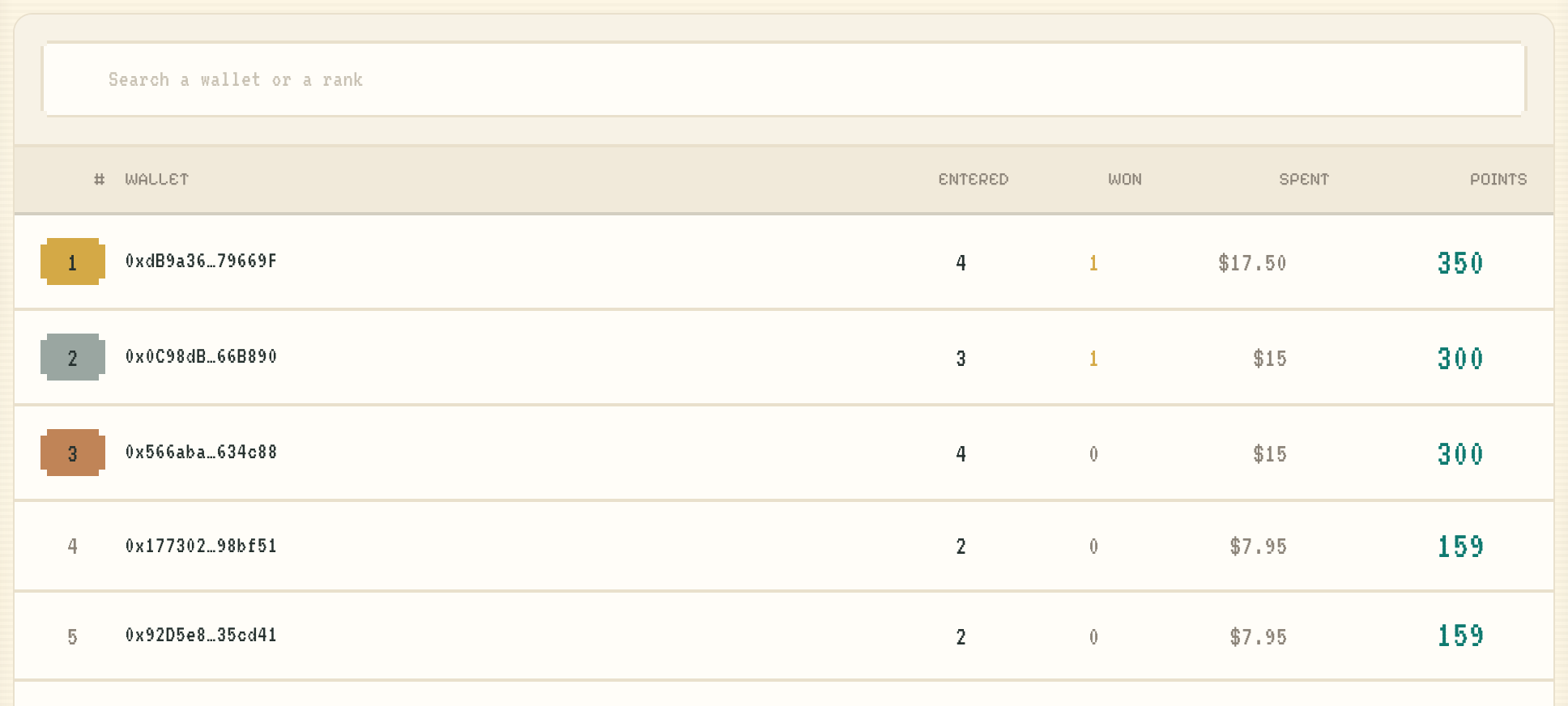
The leaderboard has no top 10, top 20 or top 30 payout cutoff.
Every 24 hours, the reward pool is divided by all qualifying points earned during that epoch. This produces one transparent price per point:
A qualifying wallet's payout is then calculated as:
Everyone receives the same value per point. A wallet with 50,000 points receives ten times as much as a wallet with 5,000 points because it contributed ten times the qualifying activity, not because it belongs to a special tier.
Why there is no cutoff
A top-N cutoff creates an arbitrary cliff. A wallet finishing 30th might be paid while the wallet finishing 31st receives nothing, even if only a few points separate them. The result could also depend on the exact second at which the epoch closes.
It would additionally encourage users to divide activity across multiple wallets to occupy more paid positions.
A proportional model removes both problems. Splitting 10,000 points across five wallets produces the same total payout as keeping all 10,000 points in one qualifying wallet.
Worked example
- You buy 2,000 entries.
- At $0.05 each, you spend $100.
- You earn 10,000 points.
- Everyone else earns 400,000 points.
- The leaderboard pool for the epoch is $5,000.
Total points equal 410,000, so:
Your illustrative payout would be:
In this example, $100 of entries returns $121.95 from the leaderboard, producing a net difference of $21.95 before gas and any other costs.
Try it with your own numbers
A point costs $0.01 and this epoch pays $0.01220. Entering is worth it while that stays above a cent.
Everyone earns the same multiple — the points cancel out of the ratio, so a wallet that spent $500 and a wallet that spent 35 cents get identical value per dollar. Your activity sets the size of your stake, never the quality of it.
Payouts accrue before withdrawal
Leaderboard rewards accrue to the user's platform balance rather than arriving as many small wallet transfers. Users can withdraw when the accumulated amount is worth the network fee.
Holding is the qualification
A wallet may still appear in the points ranking without holding a Platypus NFT, but it does not qualify for the leaderboard payout. Holding at least one Platypus is the requirement that activates the reward.
What holding a Platypus does
There are 1,999 Platypus NFTs. Within the $PLATY ecosystem, holding one connects three utilities.
Thirty percent of the $PLATY spent on official raffle entries is divided across the complete NFT collection every 24 hours. This distribution is funded by platform usage. It is not presented as a fixed yield — more official raffle activity means a larger holder pool; less activity means a smaller one.
For example, if the platform records 50,000 paid entries in one day:
- Total entry revenue: 50,000 × $0.05 = $2,500
- Burned at 70%: $1,750
- Allocated to NFT holders at 30%: $750
- Illustrative amount per Platypus: $750 ÷ 1,999 ≈ $0.375
If that exact activity level remained unchanged for 365 days, the mathematical annual total would be approximately $136.94 per Platypus. That is only a calculator example, not a promise that activity, token price or distributions will remain constant.
A Platypus NFT is required to list a raffle on the platform. This gate is intended to stop the creator side from becoming an unrestricted spam surface. No Platypus means no raffle listing.
A holder can activate a Platypus and check in each day to receive free raffle entries. Activation follows the NFT, so when it is sold, the benefit passes to its new holder.
Why the loop closes
The $PLATY economy is designed as a connected activity loop:
- People use $PLATY to enter raffles.
- Seventy percent of entry revenue is burned.
- Thirty percent is distributed to Platypus NFT holders.
- $PLATY trading fees acquire new raffle prizes and fund the points pool.
- New prizes bring participants back to the platform.
- 1Entries burn $PLATY70% destroyed
- 2NFT holders get paid30%, every 24h
- 3NFT holders create & qualifylistings, leaderboard, check-in
- 4Prizes bring entrantsfunded by trading fees
- ↻ and back to the start
Every arrow is intended to be funded by the step before it.
The design does not depend on promising a fixed payout regardless of usage. If activity declines, the amount burned, the holder distribution and the leaderboard pool all decline with it. If the platform grows, those same activity-linked figures can grow.
How the raffle draw works
The economic loop matters only if the underlying raffle is verifiable.
Platypus raffles use randomness from drand, a public randomness beacon operated by a distributed network with no connection to Platypus Inc.
The beacon's signature is verified on-chain before a winner is selected. This means the team cannot choose, replace or influence the winning wallet before or after the draw.
The NFT prize is held in escrow by the raffle contract from the moment the raffle is created. Once the draw is complete, the prize is released only to the wallet selected by the verified result.
The entries, randomness and final selection can be reproduced from public blockchain data.
In simple terms
- The prize is secured before users enter.
- Entries close when the timer ends.
- Public randomness determines the result.
- The contract verifies the randomness on-chain.
- The selected wallet receives the prize.
- Anyone can audit the draw independently.

Built for transparent activity
$PLATY is not being added beside the product as an unrelated token. It is designed to move through the product itself.
Raffle entries create burns and holder distributions. Trading activity funds proportional leaderboard rewards and new prizes. Platypus NFTs gate creation and qualification. New prizes give users a reason to return.
The result is one connected system where every major flow can be expressed as a formula, checked against public activity and understood without relying on vague promises.
Enter with $PLATY. Burn with every entry. Reward activity. Restock the board. Repeat.
See live raffles →